
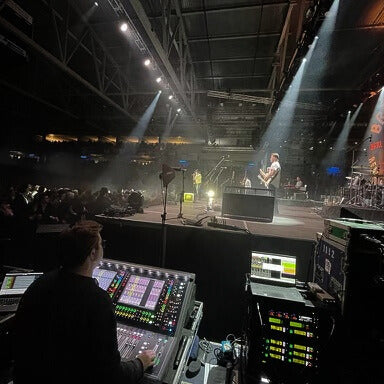
From a Musician’s Perspective
Great live sound doesn’t happen by accident. It’s the result of clear communication, mutual respect, and musicians and engineers working toward the same goal: a great show.
From the musician’s side of the stage, collaboration with engineers can make the difference between a stressful soundcheck and a confident, locked-in performance. Below are practical, experience-based tips from our very own Justin Kudding, to help musicians work more effectively with both monitor and front-of-house engineers.
1. Learn the Basics of Audio
You don’t need to be an audio engineer — but understanding the fundamentals goes a long way. Musicians who communicate issues more clearly can get faster results if they are familiar with:
- EQ (equalization)
- Gain staging
- Compression
- Effects like reverb and delay
Instead of saying: “Something sounds off…”
You can say: “My vocal feels muddy — can we pull a bit around 250 Hz?”
Why this matters: Specific requests help the engineer identify and solve problems quickly, and they signal that you’re engaged and prepared. The less time is spent guessing, the more time you get playing comfortably.
2. Choose a Point Person on Stage
One of the fastest ways to derail a soundcheck is when multiple musicians are shouting requests at the engineer at the same time. A simple solution:
- Designate one point person (often the bandleader or music director)
- Let them relay requests to the engineer
- Address one issue at a time
Why this matters: This keeps communication organized and ensures everyone gets focused attention when their turn comes. Structured communication increases efficiency and reduces frustration on both sides.
3. Stop Noodling (Yes, Really)
This one’s big — and often overlooked. Constantly playing, strumming, or warming up while the engineer is trying to work makes their job significantly harder. It creates noise that interferes with:
- Monitor adjustments
- FOH balance
- Gain and EQ decisions
Of course, you need time to:
- Check your instrument
- Dial in your tone
- Confirm your signal is working
That’s practical and necessary. But once that’s done, stand by and only play when asked.
Why this matters: Silence is a tool. Giving engineers clean moments to listen leads to better mixes for everyone.
4. Speak Both “Musician” & “Engineer”
Musicians and engineers often speak different languages — and learning both is a massive advantage.
- Musicians think in terms of feel, tone, and emotion
- Engineers think in terms of frequencies, levels, and signal flow
The best collaborations happen when:
- Engineers can interpret musician language
- Musicians can use basic technical language when needed
This is a skill worth developing, and honestly, it could be an entire blog post on its own.
Why this matters: The more fluent you are in both lexicons, the faster problems get solved — and the fewer compromises you make on your sound.
5. Be Kind, Helpful, and Patient
Engineers have one of the most demanding jobs at a live show. They’re often:
- Working under tight timelines
- Managing pressure from artists, venues, and promoters
- Responsible for both technical performance and audience experience
A calm, respectful approach goes further than frustration ever will. Simple things help:
- Saying thank you
- Being patient during troubleshooting
- Framing requests as collaboration, not criticism
Why this matters: When engineers feel respected, they’re more invested in helping you sound your best.
Key Takeaways for Musicians
- Learn basic audio concepts to communicate clearly
- Appoint a single point person for stage communication
- Avoid unnecessary playing during soundcheck
- Be specific, technical, and intentional with requests
- Treat engineers as collaborators, not obstacles
__________________________________________________________________________
From an Engineer’s Perspective
From the engineer’s side of the console, a great soundcheck is built on preparation, clear communication, and an agreed-upon process. When musicians make a few intentional choices before and during soundcheck, it dramatically improves both speed and results.
Below are practical, engineer-informed tips from Plunge Audio's James Bundy, that will help everyone get to a great mix faster.
1. Use Names (On Paper & in Real Life)
Clear identification on stage makes communication smoother and more efficient.
Including names on your stage plots — not just instruments — helps the monitor engineer avoid pointing across the stage or saying “hey you.” It allows for direct, respectful communication like, “Can I get a little more vocal from Sam?”
Learning and using the engineer’s name matters just as much. A quick introduction at the start of the day sets a collaborative tone and builds trust immediately.
Why this matters: Clear, human communication speeds up soundcheck and reduces confusion — especially on busy stages.
2. Agree on a Soundcheck Process Ahead of Time
Engineers appreciate when bands come in with a plan. Before soundcheck, communicate how you’d like to work:
- What order you prefer to check instruments
- Whether you want individual mixes dialed first
- Any known problem areas to watch for
One widely preferred approach is starting with vocals. Once vocals are set, the band can talk comfortably on stage and the engineer has a solid reference point for everything else.
Why this matters: A shared process keeps soundchecks efficient and prevents wasted time or repeated adjustments.
3. Talk to the Engineer — Without Talking to the Room
Clear communication doesn’t always mean being loud.
If your setup allows, consider using a stage talkback microphone so you can speak directly to the engineer without being heard through the PA. This is especially helpful in larger venues or loud environments where shouting across the stage creates confusion.
Why this matters: Clean communication keeps soundcheck professional, focused, and far less stressful.
4. Don’t Run Full Songs Until You’re Ready
From an engineer’s perspective, full songs during early soundcheck slow everything down. Instead:
- Play short sections when asked
- Isolate instruments or vocals
- Make focused adjustments one at a time
Once individual mixes are dialed in, full run-throughs become much more productive and enjoyable for everyone.
Why this matters: Targeted adjustments lead to better mixes faster and save your energy for the show.
5. Remember: Engineers Want You to Sound Great
Engineers aren’t gatekeepers — they’re collaborators. They’re balancing:
- Technical limitations
- Venue acoustics
- Time pressure
- The audience experience
When musicians approach soundcheck with preparation, patience, and respect, engineers are far more able to deliver the best possible result.
Why this matters: When trust exists on both sides, the mix improves and so does the entire show.
Key Takeaways for Engineers
- Encourage clear, shared communication by learning musicians’ names and roles
- Establish a soundcheck process early and communicate it clearly
- Create space for dialogue by prioritizing vocals and clean communication
- Guide soundcheck efficiently by isolating sources before full run-throughs
- Approach musicians as collaborators, not problems to manage
When musicians and engineers work together effectively, everyone wins — especially the audience.
Frequently Asked Questions
Do musicians really need to understand audio basics?
Yes. Even a basic understanding dramatically improves communication and speeds up problem-solving.
Why is noodling such a problem during soundcheck?
It creates extra noise that makes it harder for engineers to isolate issues and dial in mixes accurately.
Who should be the point person on stage?
Usually the bandleader, music director, or whoever has the clearest overview of the group’s needs.