
The IEM Seal Test:
Unlocking the Best Sound From Your Earphones
Getting a proper seal is one of the most important variables in how an in-ear monitor actually performs in your ears.
You've just unboxed a pair of highly-praised in-ear monitors. The reviews called them transparent, detailed, bass-forward, or whatever sonic profile you were chasing. You slip them in, hit play — and something feels off. The bass is thin, the soundstage is cramped, and the highs are oddly harsh. Before deciding these aren't right for you, consider the most likely culprit: you don't have a proper seal.
The IEM seal test is a deceptively simple concept with enormous consequences. It is the process of verifying that your ear canal is fully and consistently blocked by the ear tip, creating an acoustic chamber with no air leaks. When done correctly, it transforms how your IEMs sound. When ignored, even premium monitors may not sound their best.
What Is an IEM Seal, Really?
In-ear monitors are fundamentally pressure-driven transducers. Unlike open-back headphones that let sound radiate freely, IEMs work by sealing a column of air between the driver and your eardrum. The ear tip — whether silicone, foam, or hybrid — is the interface that makes this possible.
A proper seal does several things simultaneously. It blocks external ambient noise passively, which is why good IEMs isolate even without noise cancellation. More critically, it ensures that all bass frequencies generated by the driver actually travel to your eardrum instead of leaking out around the tip. Low frequencies are especially vulnerable to seal loss — they require the most air pressure and are the first to disappear when there's a gap.
A broken seal doesn't just reduce bass — it fundamentally alters the frequency response your IEM was tuned to deliver.
Every IEM is tuned and measured with a proper seal assumed. The target frequency response, bass shelf, sub-bass extension — all of it is engineered with a sealed ear canal in mind. When you break that seal even slightly, you're no longer listening to the IEM as designed. You're listening to a partially-open version of it that the manufacturer never intended.
How to Perform the Seal Test
The good news is that testing for a proper seal is quick, costs nothing, and requires no equipment beyond the IEMs themselves. Here's the approach:
-
Insert your IEMs as you normally would. Put them in however you naturally do it — this will be your baseline.
-
Cup your hands firmly over both ears. Press gently to create light pressure around the entire outer ear. You're not pressing the IEMs in; you're sealing the outer ear cavity.
-
Play a bass-heavy track or pink noise. Something with prominent sub-bass — 20 to 80 Hz — will reveal the seal most clearly. You can also use a frequency sweep going down to 20 Hz.
-
Remove your hands slowly. If the bass noticeably drops or loses weight as you uncover your ears, you have a seal leak. A properly sealed IEM should sound nearly identical with your hands cupped as without them.
-
Experiment with insertion depth and angle. Try inserting slightly deeper, angling the nozzle forward toward your nose, or rotating the IEM. Repeat the test after each adjustment.
Some musicians take an even simpler approach: simply swallow or yawn after inserting the IEM. The jaw movement shifts the ear canal shape, and if the bass suddenly deepens on swallowing, you likely just improved your seal.
The Occlusion Effect — A Bonus Check
Another way to verify seal is to hum or speak aloud with the IEMs inserted (no audio playing). If you hear a pronounced, almost uncomfortable boominess to your own voice — a low-frequency amplification of internal sound — that's the occlusion effect, and it only occurs with a good seal.
No occlusion effect, or a weak one? You almost certainly have a leak somewhere. The occlusion effect is often annoying during daily wear but it's a reliable acoustic confirmation that you're sealed in.
Why the Seal Breaks — and What to Do About It
The Ear Tip Problem
Human ear canals vary enormously in size, shape, and the angle at which they enter the skull — and a medium silicone tip that works perfectly for one person may create a persistent leak for another.
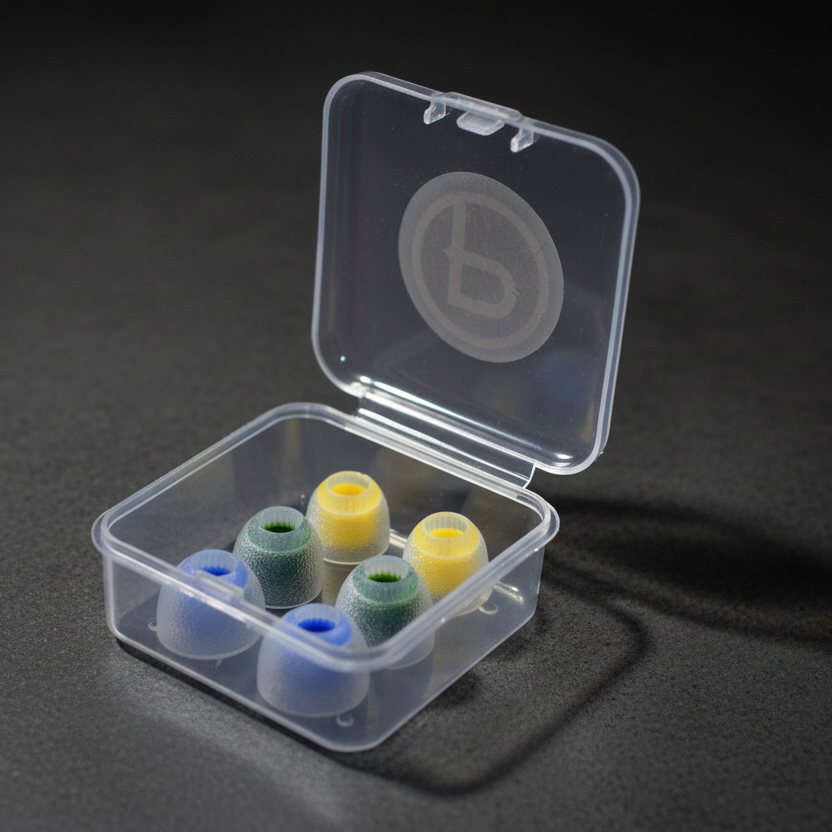
The most common solution is ear tip rolling: systematically trying different sizes and materials until you find what seals in your specific anatomy. Most in-ear monitors, like our Unity IEMs, include small, medium, and large tips, and switching to a different size often resolves the issue instantly. It's also not uncommon for your ears to need different sizes. If the included tips still don't work, checkout our accessories for other popular choices.
Insertion Depth and Angle
Many IEMs, particularly those with longer nozzles, require a deeper insertion than feels natural. This isn't uncomfortable when done correctly — the ear tip should sit at the first bend of the ear canal, not hovering at the entrance. Shallow insertion is one of the most common sources of seal failure, and it's entirely fixable once you know to look for it.
Nozzle angle matters too. Straight-barrel IEMs may need to be angled slightly forward (toward your nose) to align with your ear canal. Over-ear wear, where the cable loops up and over the ear, often improves angle and seal consistency compared to wearing the cable straight down.
Jaw and Head Movement
Your ear canal changes shape dynamically — it narrows when you open your mouth and widens when your jaw is at rest. This means an IEM that seals perfectly while you're sitting still might leak the moment you start talking or eating. If you're after consistent isolation during movement, the right silicone tip should maintain a reliable seal—even with jaw movement—while offering long-term comfort and durability. Foam tips can help in a pinch, but we generally recommend dialing in the proper silicone fit first for the best overall experience.
The Sonic Consequences, Quantified
This isn't just a subjective, vague difference. Research in acoustic engineering and audiometry has consistently shown that seal loss can alter perceived frequency response by 10 to 20 dB in the sub-bass region. That's not a subtle shift — that's the difference between hearing bass and not hearing it. For reference, 10 dB is perceived as roughly a doubling of loudness by the human ear.
Measurements of popular IEMs taken with and without a proper seal show dramatic changes in the 20–100 Hz range. Mid-bass can also suffer. Often, the upper midrange and treble can appear boosted relative to bass, causing the classic "seal leak signature" — thin, harsh, and fatiguing sound that reviewers sometimes attribute to tuning when the real culprit is fit.
| Symptom | Likely Cause | Fix |
|---|---|---|
| Thin, bass-light sound | Seal leak at tip | Larger tip size or foam tips |
| Harsh, fatiguing treble | Bass lost to leak skews balance | Deeper insertion + re-test |
| Inconsistent sound daily | Variable jaw position | Foam tips or comply foams |
| Good sound when hands on ears | Outer ear gap | Different nozzle angle / over-ear cable |
| Weak isolation | Air leaking in and out | Dual-flange or triple-flange tip |
A Note on EQ and Seal
Some listeners instinctively reach for an EQ when their IEMs sound thin. This can mask a seal problem temporarily, but it's worth checking your seal first. Boosting bass via EQ with an unsealed IEM requires more driver excursion, which can introduce distortion and potentially stress the driver over time. More importantly, once you do achieve a proper seal, your EQ settings will sound dramatically different — likely far too bass-heavy.
Fix the seal first. EQ after.
Final Word
The IEM seal test is one of those rare techniques in audio where the effort required is minimal and the potential reward is enormous. Before dismissing a pair of IEMs as poorly tuned, underperforming, or not worth the price, spend five minutes with the hand-cupping test and some tip experimentation. The IEM you bought might be exactly as good as the reviews claimed — it just needs to be sealed against your specific ear anatomy before it can prove it.
Great sound starts with physics. Physics, in this case, starts with a seal.